What Chip Restrictions May Be Teaching China
It is tempting to treat chip restrictions as a simple brake: less compute, slower AI progress. They may do that. But scarcity also changes the work worth doing, because researchers have more reason to squeeze useful results from the hardware they can reach. The US-China chip dispute matters because those two effects can happen together.
The US has restricted advanced chips and chipmaking equipment on national-security grounds, including concern about military uses of AI. The 2023 Commerce Department announcement made that rationale explicit. But the policy is not neatly described as either open access or a blanket GPU ban. Since January 2026, certain advanced chips have had a conditional, case-by-case licensing route, subject to supply assurances, safeguards, and other requirements. The Federal Register rule describes a controlled channel, not normal commercial availability.
That matters because constraints are not an on-off switch. NVIDIA’s quarterly filing for the period ending July 26, 2026 reported only partial licensed H200 shipments, alongside restrictions from China as well as the US. Its filing describes the difficulty of satisfying both governments’ requirements. Chinese labs are not operating without hardware. They are operating with less certainty about what hardware can arrive, when, and at what scale.
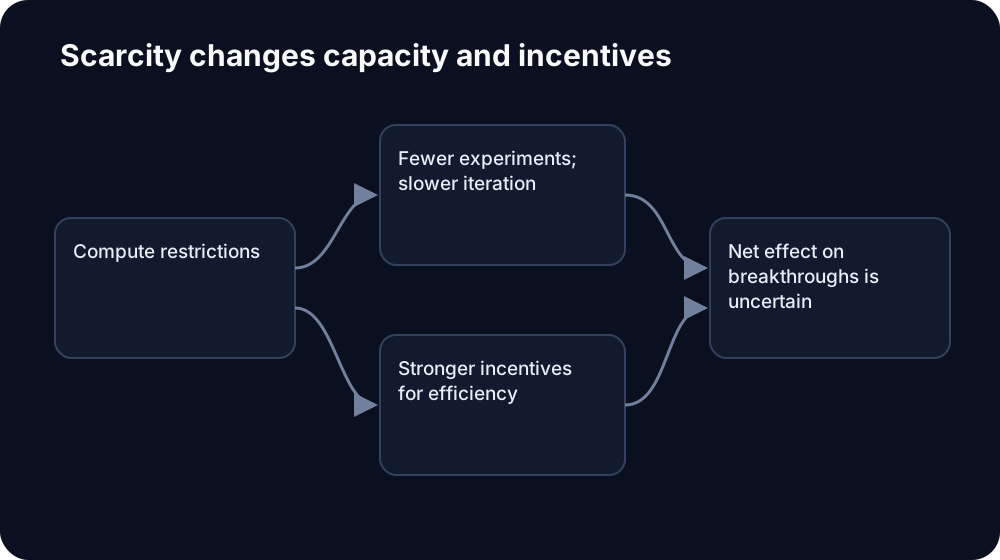
Less access to leading compute removes options. It can mean fewer training runs, smaller experiments, longer iteration cycles, and less room to pursue wasteful but potentially fruitful ideas. A lab with abundant chips can afford to train models that fail. A constrained lab has more reason to make each run count.
But that same pressure can reward work that makes a fixed cluster more useful. The important word is “reward,” not “cause.” Restrictions do not magically produce better algorithms. They can, however, change the payoff for researchers who reduce memory traffic, improve communication between chips, tune training recipes, or get more useful behavior from a smaller number of experiments.
DeepSeek is a useful example of why cost claims need careful handling. Its V3 technical report says official training used 2.788 million H800 GPU-hours, valued at $5.576 million using an assumed rental rate of $2 per GPU-hour. The report also says that figure excludes earlier research, experiments, and ablations. It describes one disclosed training run, not DeepSeek’s full development resources, and it is certainly not a comparison with the total spending of leading US labs.
The engineering work behind that run still matters. DeepSeek researchers later described V3 as hardware-aware co-design on a 2,048-H800 cluster, working around memory, computation, and interconnect limits. Their technical reflection is not a story about escaping compute constraints. It is a story about treating those constraints seriously enough that architecture and systems design become part of the model strategy.
Efficiency is not the opposite of scale. DeepSeek’s cluster was substantial. Its researchers were not training a frontier model on a few improvised machines. Large-scale training still has bottlenecks inside it: memory must move, chips must communicate, and training data and model size must be allocated sensibly. Constraints can make those bottlenecks harder to ignore.
DeepSeek’s V4 report makes a narrower efficiency claim. At a one-million-token context length, the company reports V4-Pro using 27% of V3.2’s inference FLOPs and 10% of its KV-cache memory. The V4 paper supports substantial inference savings under a specified comparison. It does not show that DeepSeek has spent less overall than American frontier labs, or that it has surpassed them across tasks.
Kimi K3 makes a related point with a different balance. Moonshot describes it as a 2.8-trillion-parameter model and says its structural and training changes achieved roughly 2.5 times the scaling efficiency of K2. Moonshot’s announcement combines a very large model with an attempt to use that scale more effectively. Efficiency can make further scaling more useful. It does not make scale irrelevant.
Its evaluation record also makes broad parity claims premature. In a July 2026 knowledge-work evaluation, Artificial Analysis reported Kimi K3 close to Fable 5 on its AA-Briefcase benchmark. But the average evaluated task cost $10.57 and took 56.4 minutes. Under a different setup, a preliminary cyber assessment by UK AISI and US CAISI found a sizeable gap: Kimi K3 averaged step 17 of 32 in a simulated network attack, compared with 28.5 for the most cyber-capable US models. NIST’s summary makes the comparison concrete.
“Near the frontier” is not a single property a model either has or lacks. It depends on the task, benchmark, cost, latency, and evaluation conditions. That is less satisfying than a scoreboard, but closer to what the evidence supports.
The wider research environment matters as much as any one model release. China has a deep base of AI education and research talent. MacroPolo’s Global AI Talent Tracker, based on a selective sample of NeurIPS 2022 papers, found that 47% of sampled top-tier researchers had undergraduate origins in China. It also found that Chinese and US undergraduate origins together accounted for 75% of the sampled talent working at US institutions. The tracker captures both Chinese training capacity and America’s ability to attract researchers.
It should not become a national-character argument. The underlying sample covers 186 papers and 867 authors, and its categories concern education and institutional affiliation. MacroPolo’s methodology does not establish citizenship, ethnicity, loyalty, or a census of everyone doing AI work. It does make a simpler point: AI talent moves through institutions, and a country’s research capacity cannot be inferred from chip inventories alone.
China’s policy ambitions are broad. Its 2025 AI Plus guideline calls for development of models, data supply, computing power, open-source ecosystems, and talent together. The government’s account documents coordination as an objective and an administrative capacity. It does not prove successful execution. Coordinated policy can reduce friction between priorities; it cannot guarantee a scientific breakthrough or erase implementation failures.
The US retains major advantages of its own. Stanford’s 2026 AI Index reports that US private AI investment in 2025 was roughly 23 times China’s recorded private investment, while cautioning that private-investment measures undercount Chinese government funding. The report’s economy section gives both facts. The gap is large. It is not a measure of each country’s total compute, or of every public and private resource that can be directed toward AI.
The intuition that restrictions might spur ingenuity should not turn scarcity into a hidden advantage. Scaling has a strong empirical basis in language-model training. Kaplan and colleagues found predictable relationships between loss, compute, data, and model size. More resources often buy more attempts at useful ideas.
Algorithmic progress changes what those resources purchase. Chinchilla showed that model size and training tokens could be better balanced under a fixed compute budget. FlashAttention reduced expensive memory movement to accelerate exact attention. These examples come from the broader research ecosystem, including the US. Efficiency research is not uniquely Chinese. A tighter resource environment raises its relative value.
Taiwan and TSMC complicate any attempt to turn this into a simple hardware scenario. Taiwan is self-governed and claimed by Beijing. The Congressional Research Service backgrounder distinguishes the claim from actual control. More importantly, even territorial control would not automatically produce uninterrupted access to TSMC’s output.
TSMC’s productive capacity depends on specialized equipment, maintenance, materials, services, and legal access across a wider supply chain. Its 2025 annual report identifies supply, equipment, geopolitical, and export-control risks. A fab is not a warehouse of finished strategic power. It is an operating network. Disrupting that network could reduce capability rather than transfer it cleanly to whoever controls the territory.
Restrictions are probably teaching China more than one lesson. They make leading hardware harder and less predictable to obtain, which slows some work. They also make systems optimization, architectural efficiency, and careful experimental allocation more commercially and strategically valuable. Observing that adaptation does not tell us what the same labs would have achieved with more compute.
The first effect is about throughput. With fewer chips or less predictable access to them, a lab can run fewer experiments in parallel, repeat fewer failed attempts, and wait longer for results that would otherwise arrive sooner. That changes the number of shots it gets and the pace at which it can learn from them. Some projects may simply be too expensive or too slow to justify.
The second effect is about attention. When runs are scarce, researchers and managers have stronger reasons to choose work that reduces costs, fits available hardware, or improves the odds that an experiment will pay off. That can redirect effort toward systems work, model design, and training choices that would receive less attention in a setting where compute is easier to waste. The distinction matters because an efficiency gain tells us that adaptation occurred, not what was lost. We cannot observe the counterfactual research program: the additional experiments, abandoned lines of inquiry, or different discoveries the same lab might have pursued with more compute. Restrictions may therefore alter both the speed of progress and the path it takes, without making either effect easy to measure.
The implication for AGI remains conditional. If progress to AGI mainly comes from continuing to scale today’s systems, limits on compute remain a serious disadvantage. If it requires a discovery that scaling alone does not guarantee, pressure to explore alternatives could matter more than current compute rankings suggest.
The evidence does not show that China will reach AGI first. It does show that scarcity can produce research priorities an abundance-shaped race might postpone. What remains unresolved is what a capable research ecosystem, forced to treat efficiency as survival rather than polish, might discover.